
Duck Commander 7500: The Right Spread for Every Sky
The Duck Commander 7500 motorised decoy system has become a staple in many hunting rigs, but its effectiveness hinges entirely on how you deploy it. A spinning-wing decoy that’s poorly positioned is just an expensive piece of plastic spinning in the wind. This guide breaks down proven spread strategies for the 7500 across different conditions, from still autumn mornings to howling prairie winds, ensuring you get the most from your investment.
How Do You Set Up the Duck Commander 7500 for Calm, Sunny Days?
On windless, bright days, ducks are notoriously wary and tend to cup and circle high before committing. The 7500’s spinning motion can look unnatural if placed incorrectly. The key is to create a subtle, low-profile spread that doesn’t scream “mechanical.”
Position the Duck Commander 7500 about 15–20 yards upwind of your blind, set on a low pole so the wings just clear the surrounding vegetation. Flank it with a handful of static decoys—four to six mallard silhouettes or full-bodies—facing into the wind. The spinning motion should be a gentle “wobble,” not a frantic blur. Reduce the motor speed using the remote’s sensitivity adjustment (most units have a low-speed setting around 50–60 RPM). This mimics a duck landing or idling, which is far more attractive on a clear day than a constant fast spin.
One common mistake is placing the 7500 directly in the middle of the decoy spread. Instead, offset it to the downwind side. This creates a visual “landing zone” that ducks naturally want to slide into. For extra realism, add a few motionless decoys on the water or ground, with heads up, to suggest a feeding or loafing group that feels safe.
What Spread Works Best for the Duck Commander 7500 in High Winds?
Wind is your friend when using a spinning-wing decoy, but it can become a liability if you don’t adjust. In sustained winds above 15 mph (24 km/h), the 7500’s wings can overspin, creating a blur that looks unnatural from above. Ducks key in on cadence, and a frantic spin can spook them.
First, use the shorter pole (or none at all if the water is shallow) to keep the decoy lower. A high-spinning decoy in heavy wind looks like a weather beacon. Set the motor to its highest speed tolerance (most 7500s have a “wind mode” that limits RPM to around 80–90). If your unit lacks that, simply turning the speed down 30% helps. Secondly, anchor the decoy with a heavy line or stake—the 7500’s base can catch wind like a sail.
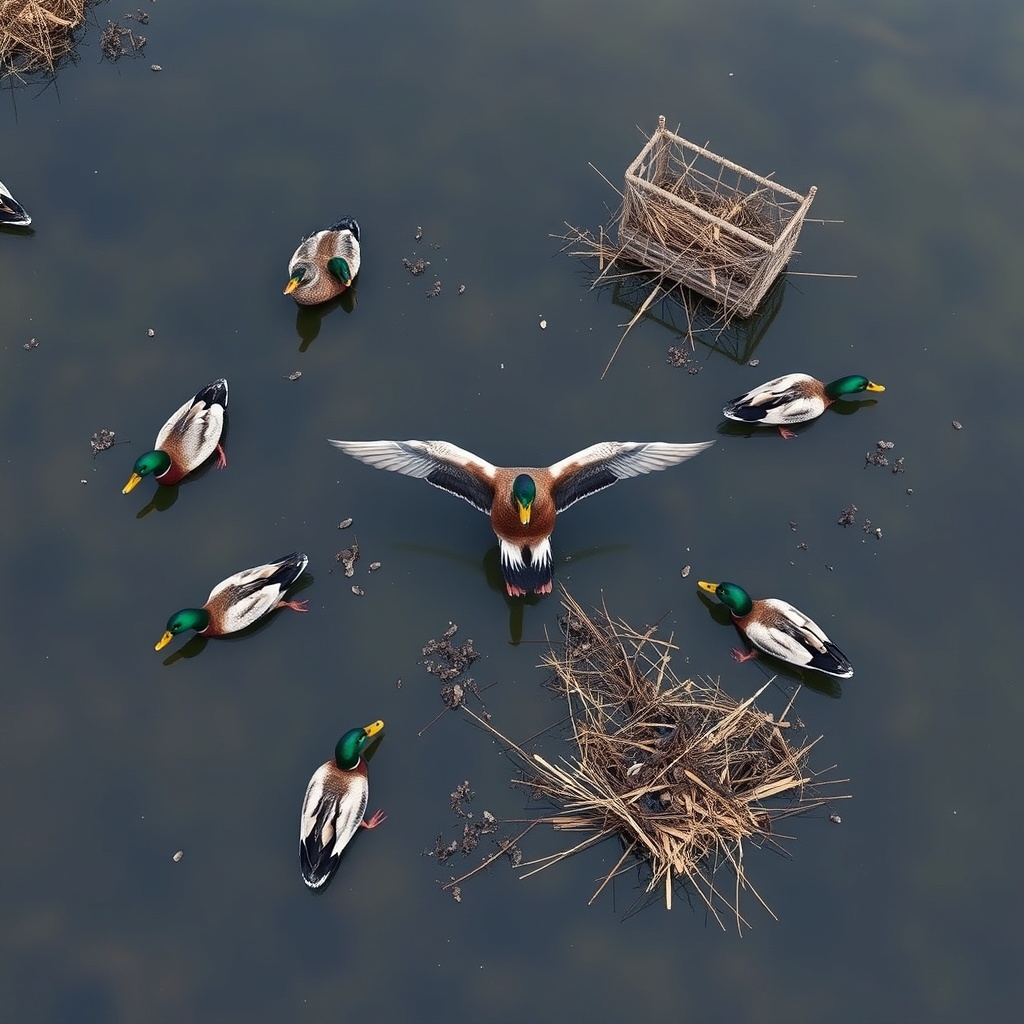
Your spread should be tight and compact. Ducks will not glide in from a mile away in wind; they’ll work the edges. Cluster six to eight static decoys right around the 7500, all facing into the wind. This creates a “pocket” where ducks feel the security of a group. Add motion to the static group using jerk rigs for water sets or motion stakes for field sets. The combination of the 7500’s spin and subtle ground-level movement is deadly in wind.
A useful trick: place a second spinning decoy (even a cheaper model) 30 yards downwind of the 7500, but running slower. This creates a visual “staircase” that draws ducks from downwind into your kill zone.
Can You Use the Duck Commander 7500 Over Water Versus Fields?
Absolutely, but the setup differs significantly. The Duck Commander 7500 comes with interchangeable poles and bases, making it versatile for both environments, but you must tailor the spread to the habitat.
Over Water: Use the longest pole (usually 48 inches / 122 cm) to raise the decoy so the wings clear the water surface. Never let the wings touch water—the drag kills the motor over time and creates a splash that flares ducks. Place the 7500 on a small, buoyant raft or a shallow-water stake that’s pushed into the mud. Spread 8–12 floating decoys in a J-hook pattern around it, with the 7500 at the hook’s heel. This funnels waterfowl into the landing zone. For deep water, use a weighted anchor line.
Over Fields: Swap to the shorter stake (24 inches / 61 cm) if you’re in cut corn or stubble. The decoy must sit just above the crop level so its wings are visible but not towering. A high pole in a field looks like a predator. Scatter 10–15 full-body or shell decoys in a loose “U” shape, with the 7500 at the open end. Ducks landing in a field want to see a clear touching-down area. Ensure the battery is protected from moisture—field dew can short connections.
For a detailed breakdown of positioning your decoys around the blind, read our Best Blind Setup for Duck Commander 7500 Decoys guide.
How Should You Adjust the Duck Commander 7500 for Late-Season Pressure?
By late November and into January, ducks have seen it all. The naive birds are gone, and the survivors are call-shy and decoy-wary. A spinning-wing decoy that looks too perfect can actually hurt you. The trick is to make the 7500 look imperfect.
First, run it intermittently. Use the remote’s on/off function to cycle the motor. Let it spin for 30 seconds, then stop it for a minute. This mimics a duck that’s landing and then settling. On several occasions, I’ve watched ducks circle a rig that had a constant spinner, only to commit when I turned it off—they felt safer approaching a “dead” decoy.
Second, adjust the wing angle slightly. Most 7500s allow you to bend the wing struts. Give one wing a slight upward twist (5–10 degrees). It’ll look like it’s been roughed up by a fight or a bad landing. This imperfection is a massive confidence booster for pressured birds. Combine this with a low-profile blind and minimal calling. For sound tactics, see our Duck Commander 7500 Hunting Call: Real-World Sound Test.
Finally, reduce your decoy spread size. Instead of 20 decoys, use 6–8. Put the 7500 off to the side, not the center. Late-season ducks need subtlety, not spectacle.
What Are the Optimal Battery and Run-Time Settings for All-Day Spreads?
Nothing kills a hunt faster than a dead spinning decoy. The Duck Commander 7500 uses a rechargeable lithium-ion battery (typically 12V, 7Ah). In ideal conditions, you can expect 6–8 hours of continuous run-time. However, cold weather (below 32°F / 0°C) can cut that by 30%.
Here’s a practical table to help you plan your battery strategy based on conditions:
| Condition | Usual Battery Drains | Needs Attention Soon |
|---|---|---|
| Temperature above 40°F (4°C) | Full 8-hour charge; run continuously at medium speed | If you run high speed for more than 2 hours, check battery level |
| Temperature 32°F–40°F (0°C–4°C) | 6–7 hours; use intermittent mode to conserve power | If the wings slow visibly after 3 hours, swap battery |
| Temperature below 32°F (0°C) | 4–5 hours; use a backup battery (recommended) | Any prolonged slow spin indicates near-depleted battery; replace immediately |
| High wind (15+ mph) | 5–6 hours due to motor strain; run at lower speed setting | If the motor whines or struggles, reduce speed to save charge |
Always carry a spare battery. A simple rule: start the day with a fresh battery, then swap to the spare at midday if you’re hunting all day. Store batteries in an inner pocket to keep them warm—cold batteries lose voltage rapidly.
How Do You Pair the Duck Commander 7500 with Other Motion Decoys?
The 7500 performs best when it’s part of a layered motion spread. A single spinner can look lonely. Pairing it with other types of motion creates a scenario ducks find irresistible. Here are three proven combinatons:
- With a jerk rig: In a water spread, run the 7500 on a low pole (just above surface) and set a jerk rig with 4–6 decoys 10 yards away. The smooth pull of the jerk rig mimics feeding ducks, while the 7500 adds a visual “landing” cue. The contrast in motion types (spinning vs. bobbing) looks incredibly natural.
- With a motion stake or “swimmer” decoy: In a field, place a motion stake (like a Mojo Critter) 15 yards downwind of the 7500. The stake adds a different rhythm—a bobbing, wobbling motion that breaks up the pattern. Ducks key in on this diversity.
- With a second 7500: Running two 7500s on opposite sides of the spread can be effective, but you must run them at different speeds. Set one to 60 RPM and the other to 80 RPM. This prevents them from looking like a mechanical pair and mimics two independent ducks. For a direct comparison with another top system, read our Duck Commander 7500 vs Mojo Elite Series: Which Decoy System? analysis.
What Owners Say
Hunters who have used the Duck Commander 7500 for multiple seasons share consistent insights. One common observation is that the decoy’s durability is better than expected, but the remote range can be an issue. “In thick reeds, the remote works best within 30 yards,” notes a Wisconsin waterfowler. “Beyond that, I’ve had it fail to change speed. I keep the remote on a lanyard around my neck now.”
Another frequent point is the effectiveness of the “slow mode” for pressured birds. “I used to run it full speed all day,” says an Arkansas guide. “Last season, I kept it on the lowest setting, and my decoy-to-shot ratio improved noticeably. Ducks don’t like frantic motion.” Finally, owners stress the importance of cleaning the wing hubs after each hunt. “If you hunt saltwater or muddy fields, the bearings can gum up. A quick spray of silicone lube every three hunts keeps it spinning smooth.”
Frequently Asked Questions
Can the Duck Commander 7500 handle rain or snow?
Yes, the motor housing is weather-sealed, but prolonged heavy rain can seep into battery connections. Wipe the battery contacts dry before connecting, and store the unit upside-down overnight to drain any moisture. Avoid submerging the motor.
How many decoys should I use with the 7500?
For most situations, 6–12 static decoys paired with one 7500 create an effective spread. More than 20 can look unnatural, especially in late season. Focus on quality, realistic decoys in proper positions rather than large numbers.
What is the decibel level of the 7500 motor?
At typical operating speed, the motor measures around 45–50 dB from 10 feet away—about as loud as a quiet conversation. It won’t spook ducks, but in dead silence, you’ll hear the hum. Running it on intermittent mode reduces this concern.
Can I use the remote with multiple 7500s?
Yes, the remote can pair with multiple units, but you must set each to a different channel (usually channels 1–4). Check your manual for the specific pairing procedure. Running two on the same channel will control both simultaneously, which can be useful.
How do I store the Duck Commander 7500 in the off-season?
Remove the battery and store it separately at around 50% charge in a cool, dry place. Clean the wing hubs and apply a light oil. Store the body in a padded case or box to prevent wing damage. Inspect the rubber feet on the base annually—they can crack over time.
Is the 7500 effective for all duck species?
It’s most effective for mallards, pintails, and wigeon. Divers like canvasbacks and scaup can be drawn to the motion, but they often prefer larger, tighter spreads. For teal, the 7500 can be too large—consider a smaller spinner for those fast, small birds.